CarouselGenerative AI
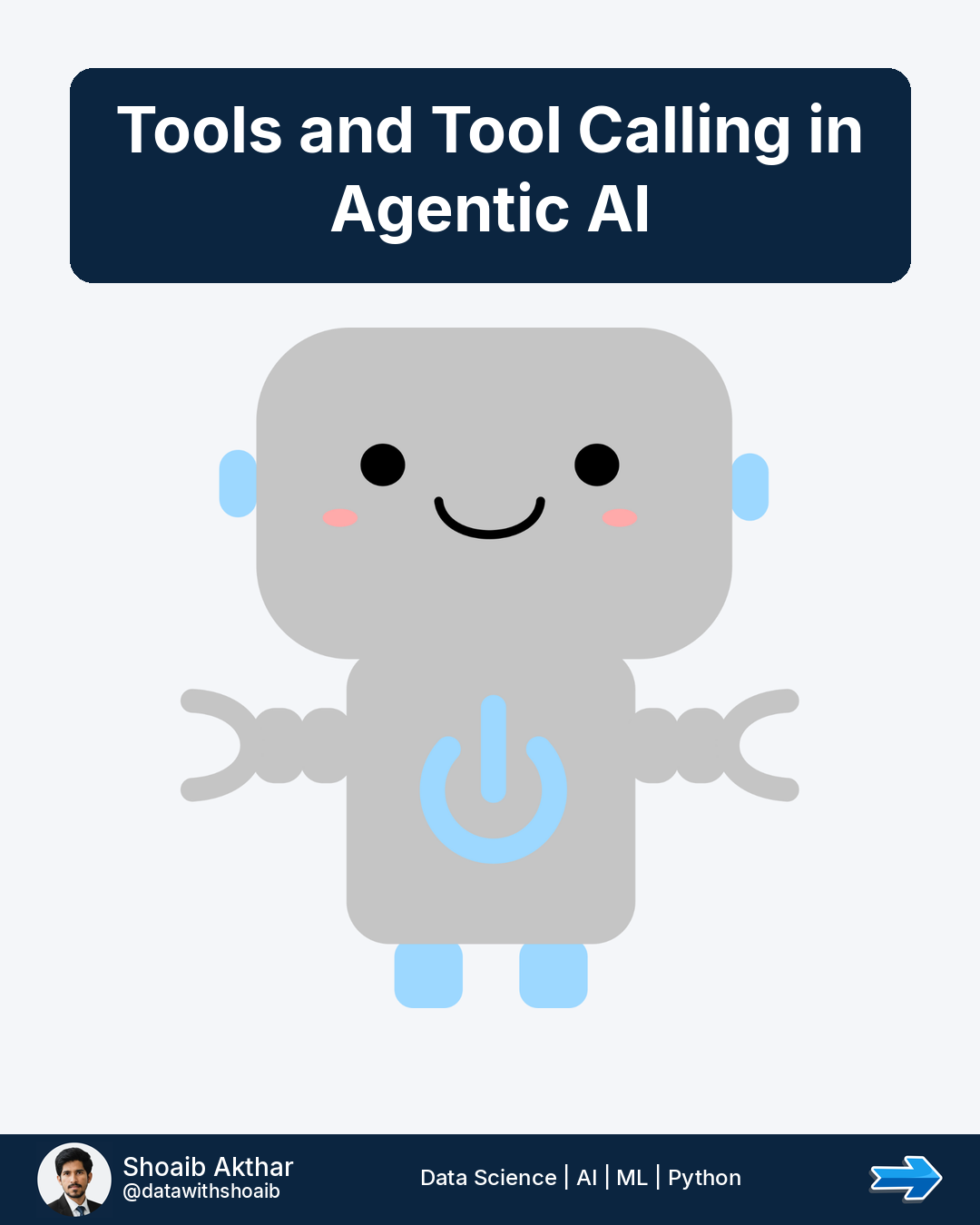
Tools and Tool Calling in Agentic AI
What Are Tools in Agentic AI? Tools are external capabilities that an AI agent can use to perform tasks beyond generating text.
 1 / 10
PDF not showing? Open it in a new tab.
Read it as text
The full carousel content, slide by slide.
01What Are Tools in Agentic AI?
- Tools are external capabilities that an AI agent can use to perform tasks beyond generating text.
- Examples include web search, calculators, databases, APIs, code execution, and file systems.
- Tools allow an AI agent to interact with the outside world instead of only producing responses.
- An LLM can reason about a task, but tools give it the ability to retrieve information or perform actions.
- This transforms AI from a question-answering system into a task-performing system.
02Why Do AI Agents Need Tools?
- LLMs have limitations: their knowledge may be outdated and they cannot directly access every external system.
- They may also struggle with precise calculations, large datasets, and real-time information.
- Tools solve these limitations by giving agents access to specialized capabilities.
- A financial agent can query market data, while a coding agent can execute code and inspect the output.
- The LLM provides the intelligence, while tools provide the capabilities.
03What Is Tool Calling?
- Tool calling is the mechanism that allows an AI model to request the use of a specific tool.
- The model doesn't directly execute the tool; it generates a structured request describing what the application should do.
- The application receives the request, executes the tool, and sends the result back to the model.
- The model then uses the result to continue solving the task.
- The basic loop is: Think → Call Tool → Observe → Think Again → Act.
04How Tool Calling Actually Works
- Developers first provide the AI model with available tools and their input schemas.
- The user gives the agent a task that may require one or more tools.
- The model decides whether a tool is necessary and selects the appropriate one.
- The application executes the tool using the arguments generated by the model.
- The tool's output is returned to the model, which uses it to produce the final response or make another tool call.
05One Agent Can Use Multiple Tools
- Real-world tasks rarely require only one capability.
- An AI agent might use a web search tool to find information, a database tool to retrieve internal data, and a calculator to analyze the results.
- It can decide which tool to use based on what it needs at each step.
- Tools can also be called multiple times during a single task.
- Combining multiple tools allows agents to solve complex, multi-step workflows.
06Tool Calling vs Function Calling
- Function calling is a common mechanism through which AI models interact with external functions.
- Tool calling is the broader concept of allowing a model to interact with different external capabilities.
- A function might retrieve customer information, while another tool could search the web or execute code.
- The terminology differs across AI frameworks and platforms.
- The underlying idea remains the same: the model decides what capability it needs and provides structured arguments to use it.
07What Makes a Good Agent Tool?
- A good tool should have a clear purpose and a well-defined input/output structure.
- Tool descriptions should be specific enough for the model to understand when and how to use them.
- Inputs should be validated because the model can generate incorrect or unexpected arguments.
- Tools should return useful, structured results instead of unnecessary information.
- Good tools are designed around real tasks rather than simply exposing every possible API.
08Tools Are the Hands of an AI Agent
- An LLM can reason, plan, and decide, but without tools its ability to interact with the real world is limited.
- Tools give agents access to data, computation, software systems, and real-world actions.
- Tool calling provides the connection between the model's reasoning and those external capabilities.
- As agents become more autonomous, the number and variety of tools they can safely use will continue to grow.
- The future of Agentic AI isn't just about smarter models; it's about smarter models connected to the right tools.